
The Vendor With No Org Chart
Your third-party risk program assumes the company you're assessing is a company.
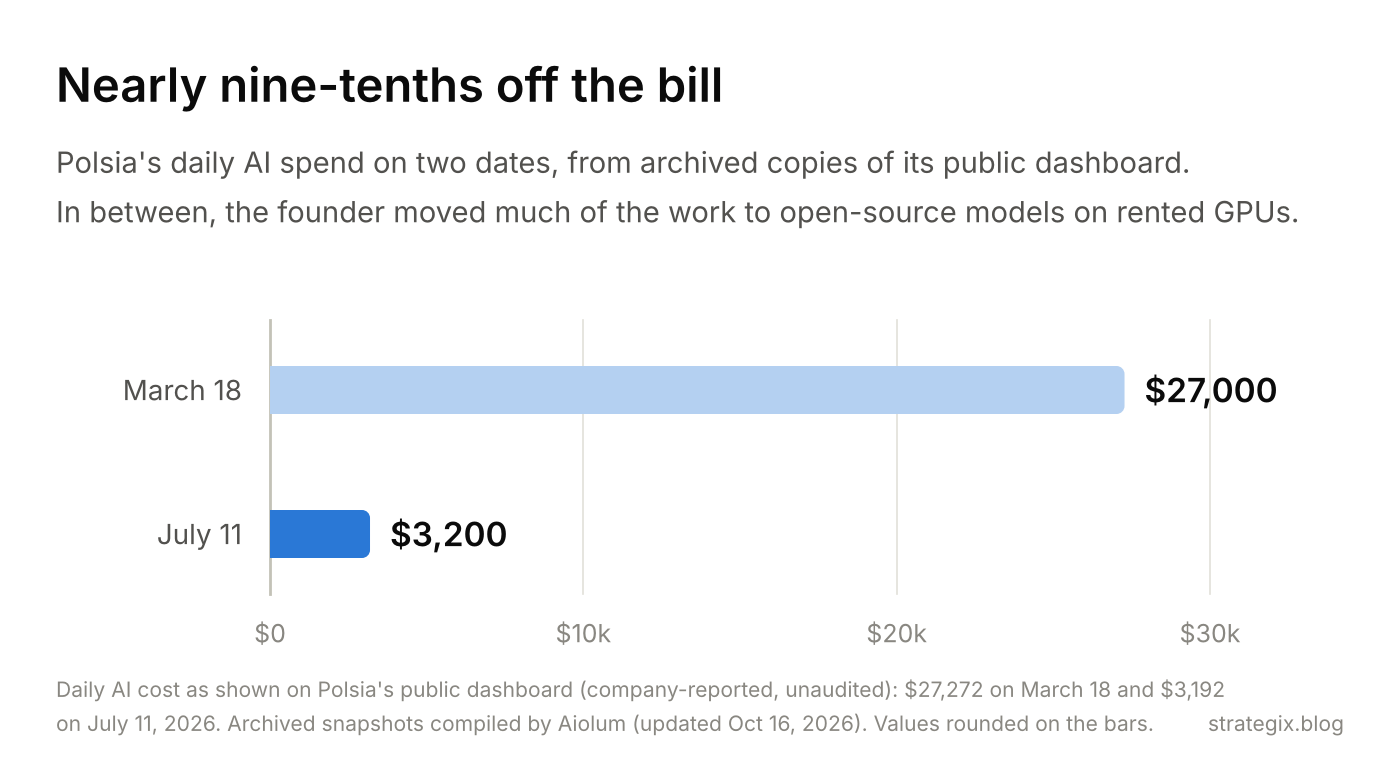
Somewhere between spring and summer, a vendor serving thousands of paying customers changed the AI doing their work. The founder had built the product on Anthropic's Claude, and his cost per task kept climbing as customers' codebases grew. So he moved much of the work to open-source models running on rented GPUs. Archived copies of the company's public dashboard show its daily AI bill falling from about $27,000 in March to about $3,200 in July.
The company is Polsia, and its founder, Ben Broca, is the only human in it. The Wall Street Journal profiled it in July. By his count it has 10,000 paying customers and is on track for $10 million in revenue this year. None of those figures is audited. True Ventures is among the investors.
Polsia sells to founders, so it may never reach your inventory. Something built the same way will. Ask which of your controls would have caught that model change, and answer with the controls you actually run.
Pull up Shared Assessments' SIG or the Cloud Security Alliance's CAIQ and read it as an anthropologist would. Segregation of duties between development and production. Background checks for anyone with privileged access. An incident response team with named roles and an escalation path. A continuity plan with alternates. Access reviews performed by someone other than the account holder.
Every one of those questions is really a question about whether a second person exists.
Run them against a company of one and you get honest answers that mean nothing. Yes, there is an incident response process, and it is the founder. Yes, access reviews happen every quarter, performed by the account holder on himself. Yes, there is a continuity plan, and the alternate contact is a personal Gmail account. The questionnaire passes cleanly and tells you nothing you needed to know.
For years a SOC 2 Type II worked as a rough proxy for a real organization. Assembling the evidence took a function, and the bill rose with headcount. Buyers priced that link into their trust without ever writing it down.
Compliance automation broke that link. The controls those platforms handle best are the ones a solo operator can meet alone: MFA enforced, disks encrypted, laptops enrolled, policies acknowledged, scans on a schedule. In August, Drata published a customer story titled "One founder, one laptop, one path to SOC 2," about a single founder working toward a Type II. A clean report says the controls operated. Whether one person operated all of them is a question your reviewer has to ask, and I'm sure there is nothing in your template that prompts it.
The Substitution Test replaces the organizational controls that no longer apply, for any vendor whose headcount you cannot verify.
Substitution latency. How fast can a material dependency change? For a one-person AI vendor, the model provider, the inference host, the payment processor and the email service are all API keys and a redeploy. At a 200-person vendor, changing the model behind a production workload is a project with a change board and a rollback plan. At a company of one it's a Tuesday.
Disclosure trigger. What in your contract obliges them to tell you? Most sub-processor clauses run off a named list with a notice window. Moving from a frontier lab's API to open weights on rented GPUs takes one name off that list. If anyone honors the clause, it also adds a GPU host your privacy team has never assessed. The notice depends on the vendor remembering to send it, and the person who would remember is also writing the code and answering support.
Continuity floor. If the one human stops, what keeps running, and for how long?
Small vendors always carried key-person risk, and your tiering already prices it. When a three-person startup loses its founder, the product degrades and support goes dark. You notice, and you invoke the exit plan. Every exit plan you have ever written assumes the vendor stops.
Now read how Polsia works. Every night its agents start on their own, pick the next action for each customer's company, carry it out and email the owner a report on what they did and what comes next. The homepage calls it "your AI co-founder that never sleeps." None of that needs the founder awake. If he walked away tomorrow, the agents would keep running and the renewals would keep firing. Nothing would look broken, and nobody would call you.
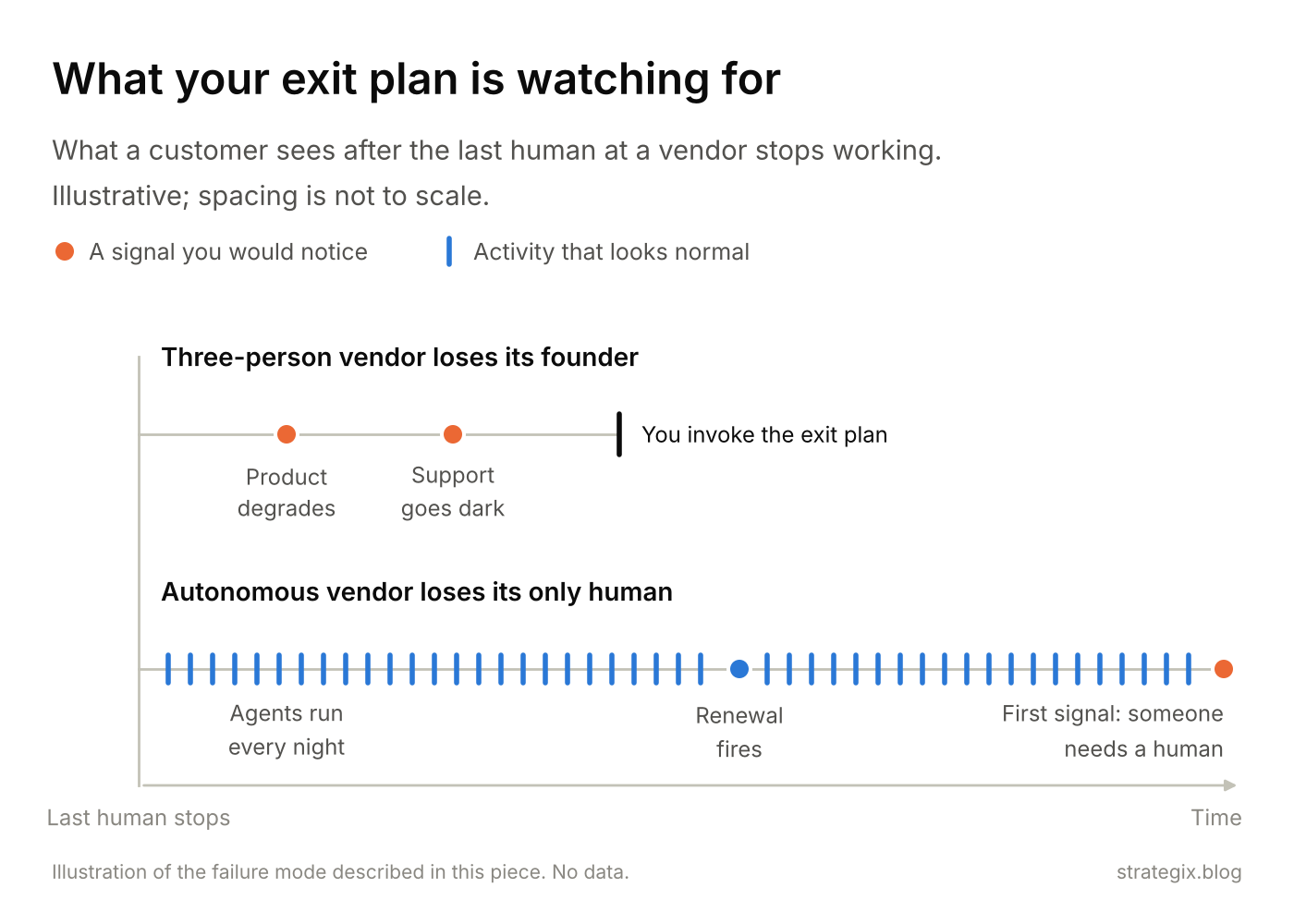
Your monitoring is built to detect stoppage, and the characteristic failure of an autonomous vendor is the opposite: continued operation with no accountable human attached. No page fires. No service level is breached. A system keeps processing your data for an entity that has effectively ceased to exist. Your first signal arrives the day someone finally needs a human on the other end of the phone.
Add a headcount and key-person question at intake, and use the answer to send single-operator vendors to a second tier of diligence. Banning them outright would cost you some of the best tools in your stack, so I advise against it.
Then rewrite the model question. "Do you use DeepSeek?" gets an honest no from a vendor running open weights on rented GPUs, whoever trained them. That question was written for an app. New York's February 2025 ban stopped the DeepSeek app from being downloaded onto state-managed devices and networks, and it says nothing about weights running on someone else's hardware. Ask whose weights they are and where they run. Stop asking about names and brands.
The more difficult adjustment is contractual. The clause that carries the weight is a substitution notice floor paired with a named continuity contact. Drafting it is fiddlier than it sounds, because you are writing a notice obligation for a company with nobody to staff the notice.
Pull your vendor inventory now and sort it by annual spend. Scroll to the bottom quartile, to the tools that came in under the approval threshold and have renewed on a card ever since.
Count how many of them you could name a second employee at.
Then ask who would call you if the first one stopped.